
Experimental manipulation of cell identity – achieved through coordinated transcriptional, epigenetic, and metabolic remodeling – defines what researchers now call cellular reprogramming. Aging, injury, and chronic disease progressively erode the functional capacity of differentiated tissues, and reprogramming offers a conceptual basis for reversing that erosion. This article moves from foundational concepts and molecular mechanisms through to therapeutic applications and the unresolved risks that still complicate clinical translation.
What Cellular Reprogramming Resets at the Molecular Level

At the heart of reprogramming are four transcription factors-Oct4, Sox2, Klf4, and c-Myc, collectively abbreviated as OSKM-whose coordinated expression can push a mature somatic cell toward a pluripotent state. When introduced into adult cells, these factors bind chromatin at thousands of sites, progressively opening regions that were silenced during development and closing others that defined the cell’s original identity.
The molecular changes are extensive. DNA methylation patterns accumulated over decades are erased and rewritten, histone modifications shift from repressive marks like H3K27me3 toward activating ones, and mitochondria transition from the oxidative metabolism typical of differentiated cells back toward glycolysis, which characterizes embryonic stem cells.
Full reprogramming produces induced pluripotent stem cells capable of generating any tissue type. Partial or transient reprogramming, by contrast, initiates this cascade without completing it-attenuating senescence-associated gene expression and restoring youthful transcriptional profiles while preserving cell identity. This staged nature means reprogramming is less a reversal of age than a selective molecular reset.
How Scientists Induce Reprogramming and Test Repair
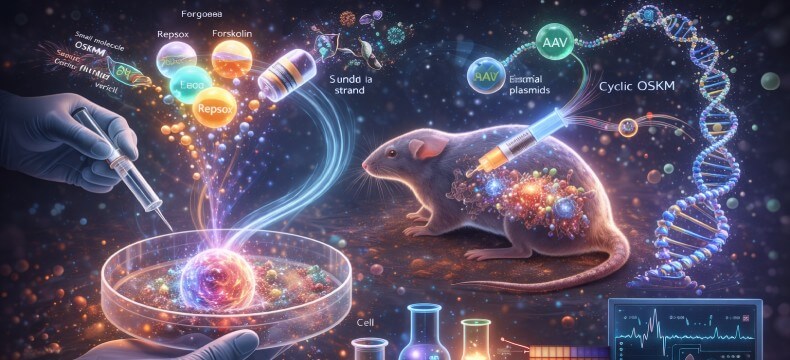
Delivery method shapes nearly everything about how reprogramming experiments succeed or fail. Early approaches relied on integrating retroviruses to introduce the Yamanaka factors-OCT4, SOX2, KLF4, and c-MYC-but insertional mutagenesis posed obvious safety concerns. Non-integrating alternatives followed: modified mRNA, episomal plasmids, and Sendai virus vectors can transiently express reprogramming factors without permanently altering the genome, substantially improving safety profiles for translational applications.
Small-molecule cocktails represent a chemically defined alternative, with combinations such as CHIR99021, Repsox, and forskolin shown to drive partial or full reprogramming in mouse somatic cells without any exogenous genetic material. In vivo delivery using adeno-associated viral vectors has enabled tissue-specific, cyclic OSKM expression in living animals, a strategy that avoids full dedifferentiation while still reversing epigenetic age markers.
Verification depends on multiple convergent assays. Epigenetic clocks based on DNA methylation patterns, such as the Horvath clock, quantify biological age reversal. Transcriptomic profiling confirms restoration of youthful gene-expression signatures. Functional recovery provides the most compelling evidence: studies in aged mice have demonstrated partial restoration of retinal ganglion cell function following cyclic OSK expression, while hepatocyte reprogramming models show measurable improvements in liver regenerative capacity after injury.
Repair Is Promising, but Control Remains the Central Challenge
It is a scientific and now even well-argued prediction that cell fate and certain aspects of cellular aging are far more plastic than classical biology had supposed. Induced pluripotency, partial reprogramming, and epigenetic rejuvenation have demonstrated that aged, differentiated, or damaged cells have the capacity to reset – a truth with significant implications for disease modeling, regenerative medicine, and tissue repair. Nevertheless, the clinical translation remains far off. The reprogrammed cells are at risk of teratoma formation, particularly when pluripotency factors like c-Myc remain active unduly. Partial reprogramming leaves cells with some remnant of epigenetic memory, which destroys lineage fidelity. Cascades of off-target effects and difficulties target reprogramming signals to only specific cell populations in vivo. The most pertinent question at present is not whether cells can be reset – they can – but whether the reset will be safe, exact, and temporary enough such that the reprogrammed cells from bench models can be taken into the patient bearing no new pathology in lieu of the old.